
KING STEVE TOUR: Oldupai Gorge & Laetoli
KING STEVE TOUR: Oldupai Gorge & Laetoli: Over the last thirty years or so, it has become increasingly apparent that Africa is probably the “Cradle of Mankind”. From Africa they ...


KING STEVE TOUR: Walking SafarisWalking in and around the NCA encou...
KING STEVE TOUR: Walking SafarisWalking in and around the NCA encou...: Walking Safaris Walking in and around the NCA encouraged, but should be done with guides. Short hikes can be organized with your lodge...
Oldupai Gorge & Laetoli
Over the last thirty years or so, it has become increasingly apparent that Africa is probably the “Cradle of Mankind”. From Africa they spread out to populate the rest of Earth. Remains of the earliest humans were found in Oldupai Gorge.
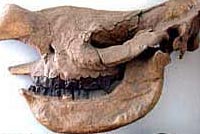 Oldupai
Gorge (originally misnamed Olduvai) is the most famous archaeological
location in East Africa, and has become an essential visit for travelers
to Ngorongoro or Serengeti.
Oldupai
Gorge (originally misnamed Olduvai) is the most famous archaeological
location in East Africa, and has become an essential visit for travelers
to Ngorongoro or Serengeti.At Laetoli, west of Ngorongoro Crater, hominid footprints are preserved in volcanic rock 3.6 millions years old and represent some of the earliest signs of mankind in the world. Three separate tracks of a small-brained upright walking early hominid. Australopithecus afarensis, a creature about 1.2 to 1.4 meters
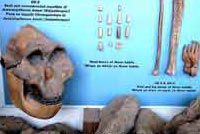 high, were found. Imprints of these are displayed in the Oldupai museum.
More advanced descendants of Laetoli’s hominids were found further north, buried in the layers of the 100 meters deep Oldupai Gorge. Excavations, mainly by the archaeologist Louis and Mary Leakey, yielded four different kinds of hominid, showing a gradual increases in brain size and in the complexity of their stone tools. The first skull of Zinjanthropus, commonly known as ‘Nutcracker Man’ who lived about 1.75 millions years ago, was found here. The most important find include Home habilis, Zinjathropus and the Laetoli footprints.
The excavation sites have been preserved for public viewing and work continues during the dry seasons, coordinated by the Department of Antiquities. One may visit Oldupai at all times of the year. It is necessary to have official guide to visit the excavations. At the top of the Gorge there is small museum, a sheltered area used for lectures and talks, toilets and a cultural boma. Local Maasai souvenirs are also available.
Thus, Oldupai and Laetoli makes the Ngorongoro Conservation Area an important place in the world for the study of human origins and human evolution.
Cultural Bomas
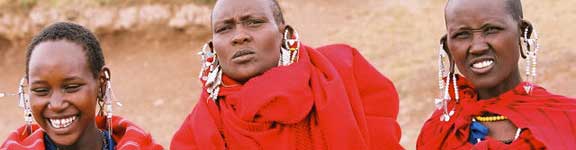 One can visit the Maasai Cultural bomas in the NCA to learn more
about their unique culture, to take photographs, and to buy mementos.
There is an entrance fee to be paid but it is well worth it. Please
be sensitive to the fact that it is considered bad manners to take
photographs of people along the roadside without consent. A visit to one of the following is highly recommended:
One can visit the Maasai Cultural bomas in the NCA to learn more
about their unique culture, to take photographs, and to buy mementos.
There is an entrance fee to be paid but it is well worth it. Please
be sensitive to the fact that it is considered bad manners to take
photographs of people along the roadside without consent. A visit to one of the following is highly recommended:- Kiloki Senyati Cultural Boma
Situated on the main road to Serengeti, 7 km south-west of the Olduvai Gorge Information Center - Loonguku Cultural Boma
Situated on the main road to Serengeti, 10km before the turn-off to Olduvai Gorge - Irkeepusi Cultural Boma
Situated 2km north-east of Lemala mini gate, on the main road to Empakaai - Seneto Cultural Boma
Situated just west of the Seneto Gate, within the Malanja Depression
People and Culture (Maasai)
People and Culture (Maasai)
 For
thousands of years a succession of cattle herding people moved into the
Area, lived here for time, and then moved on, sometimes forced out by
other tribes.
For
thousands of years a succession of cattle herding people moved into the
Area, lived here for time, and then moved on, sometimes forced out by
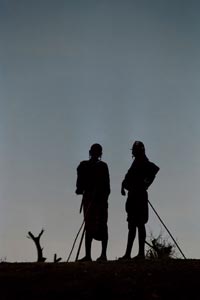
other tribes.About 200 years ago the Maasai arrived and have since colonized the Area in substantial numbers, their traditional way of life allowing them to live in harmony with the wildlife and the environment. Today there are some 42,200 Maasai pastoralists living in the NCA with their cattle, donkeys, goats and sheep. During the rains they move out on to the open plains; in the dry season they move into the adjacent woodlands and mountain slopes. The Maasai are allowed to take their animals into the Crater for water and grazing, but not to live or cultivate there. Elsewhere in the NCA they have the right to roam freely.
Visitors are welcomed at two designated Maasai cultural bomas one on the road to Serengeti and another close to Sopa Lodge at Irkeepusi village.
The Datoga, Nilo-Hamitic-speaking pastoralists, who arrived more than 300 years ago and were subsequently forced out of the Serengeti-Ngorongoro area by the Maasai, today they live just outside the NCA, in the Lake Eyasi basin and beyond.

Walking Safaris
Walking in and around the NCA encouraged, but should be done with guides. Short hikes can be organized with your lodge or the NCAA headquarters. Long walks can be adventurous and rewarding but need some planning.Suitable walking routes include the area from Olmoti Crater to Embakai Highlands and down to the Great Rift Valley, the Northern Highlands Forest Reserve and the Eastern Plains around Nasera Rock, Gol Mountains and Olkarien Gorge.
Subscribe to:
Comments (Atom)