

Mikumi National Park abuts the
northern border of Africa's biggest game reserve - the Selous – and is
transected by the surfaced road between Dar es Salaam and Iringa. It is
thus the most accessible part of a 75,000 square kilometre (47,000
square mile) tract of wilderness that stretches east almost as far as
the Indian Ocean.
Mikumi is the fourth-largest park
in Tanzania with the size of 3,230 sq km (1,250 sq miles), and part of
a much larger ecosystem centred on the uniquely vast Selous Game
Reserve.
Location: 283 km (175 miles) west of Dar es Salaam, north of Selous, and en route to Ruaha, Udzungwa and (for the intrepid) Katavi.
Location: 283 km (175 miles) west of Dar es Salaam, north of Selous, and en route to Ruaha, Udzungwa and (for the intrepid) Katavi.
The open horizons and abundant
wildlife of the Mkata Floodplain, the popular centrepiece of Mikumi,
draw frequent comparisons to the more famous Serengeti
Plains.Criss-crossed by a good circuit of game-viewing roads, the Mkata
Floodplain is perhaps the most reliable place in Tanzania for sightings
of the powerful eland, the world’s largest antelope. The equally
impressive greater kudu and sable antelope haunt the miombo-covered
foothills of the mountains that rise from the park’s borders.
Lions survey their grassy kingdom –
and the zebra, wildebeest, impala and buffalo herds that migrate across
it – from the flattened tops of termite mounds, or sometimes, during
the rains, from perches high in the trees. Giraffes forage in the
isolated acacia stands that fringe the Mkata River, islets of shade
favoured also by Mikumi's elephants.
More than 400 bird species have
been recorded, with such colourful common residents as the
lilac-breasted roller, yellow-throated longclaw and bateleur eagle
joined by a host of European migrants during the rainy season. Hippos
are the star attraction of the pair of pools situated 5km north of the
main entrance gate, supported by an ever-changing cast of waterbirds.


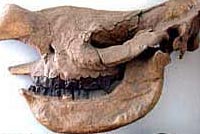 Oldupai
Gorge (originally misnamed Olduvai) is the most famous archaeological
location in East Africa, and has become an essential visit for travelers
to Ngorongoro or Serengeti.
Oldupai
Gorge (originally misnamed Olduvai) is the most famous archaeological
location in East Africa, and has become an essential visit for travelers
to Ngorongoro or Serengeti.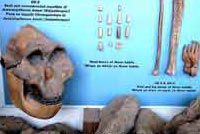 high, were found. Imprints of these are displayed in the Oldupai museum.
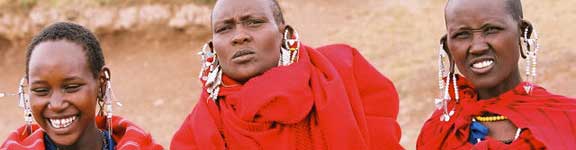 One can visit the Maasai Cultural bomas in the NCA to learn more
about their unique culture, to take photographs, and to buy mementos.
There is an entrance fee to be paid but it is well worth it. Please
be sensitive to the fact that it is considered bad manners to take
photographs of people along the roadside without consent. A visit to one of the following is highly recommended:
One can visit the Maasai Cultural bomas in the NCA to learn more
about their unique culture, to take photographs, and to buy mementos.
There is an entrance fee to be paid but it is well worth it. Please
be sensitive to the fact that it is considered bad manners to take
photographs of people along the roadside without consent. A visit to one of the following is highly recommended: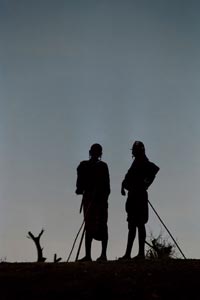 For
thousands of years a succession of cattle herding people moved into the
Area, lived here for time, and then moved on, sometimes forced out by
other tribes.
For
thousands of years a succession of cattle herding people moved into the
Area, lived here for time, and then moved on, sometimes forced out by
other tribes.